Korea Treasury Yields Rise as Middle East War Risk Lifts 3-Year Note to 3.887%
Korean government bond yields climbed on July 14. Concerns over a renewed U.S. maritime blockade against Iran drove oil prices higher and revived inflation pressure. The 3-year Treasury yield ended at 3.887%. Traders are watching oil, the won, and the Bank of Korea’s policy path.
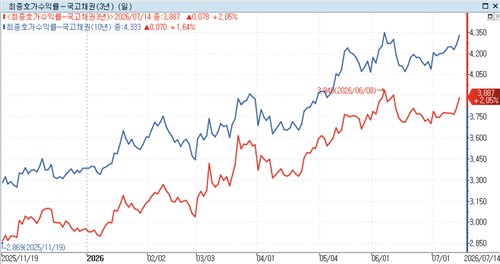
Korean government bond yields rose across maturities on July 14, with the 3-year Korea Treasury Bond closing at 3.887%. The market priced in renewed inflation risk after concerns over a possible restart of U.S. maritime blockade measures against Iran drove global oil prices sharply higher.
Oil Shock Moves Into Bond Pricing
For Korea, higher crude prices quickly affect import costs because the economy depends heavily on overseas energy supplies. A stronger oil price also risks widening pressure on the trade balance and lifting won-denominated import prices if the Korean won weakens. That combination reduces confidence that inflation will cool smoothly.
Policy Expectations Shift
The 3-year KTB is highly sensitive to expectations for the Bank of Korea’s base-rate path. A jump in oil prices can raise producer prices, transport costs, and inflation expectations, making investors less willing to price in early rate cuts. Higher sovereign yields can also feed into bank bonds, corporate bonds, and fixed-rate household loans.
Market Impact
Rising yields mean falling bond prices, creating valuation losses for existing bondholders and bond funds. New buyers, however, face improved coupon and reinvestment opportunities. The next direction for Korean Treasury yields depends on Middle East risk, oil prices, the won-dollar exchange rate, and the central bank’s inflation assessment.
Key points
- Korean government bond yields climbed on July 14. Concerns over a renewed U.S. maritime blockade against Iran drove oil prices higher and revived inflation pressure. The 3-year Treasury yield ended at 3.887%. Traders are watching oil, the won, and the Bank of Korea’s policy path.
- Use the body and FAQ context before acting on this update.
- Compare with related issues inside the category hub.
FAQ
Why did Korean government bond yields rise?
Oil prices surged on renewed Middle East risk, increasing inflation concerns and reducing confidence in early Bank of Korea rate cuts.
What was the 3-year Korea Treasury yield?
The 3-year Korea Treasury Bond yield closed at 3.887% on July 14.
How does this affect households and companies?
Higher Treasury yields can lift bank and corporate borrowing costs, adding pressure to refinancing and fixed-rate loan pricing.
Latest stories

Chip boom meets a cold job market as Korea faces growth without broad hiring
Korea’s semiconductor industry has entered a powerful upcycle on AI server and high-bandwidth memory demand, yet the labor market remains cold. Capital spending is going into cleanrooms, tools, automation and software, while new hiring is concentrated in experienced and advanced technical roles. The gap between better won-denominated earnings and weak job cr
Card Loan Rates Fall for Low-Credit Borrowers, Rise for Prime Users
Card loan rates are moving in opposite directions by credit profile. Lower-credit borrowers are receiving reduced rates, while high-credit borrowers are seeing increases. The shift reflects card companies’ broader push into mid-rate loans and tighter management of funding costs and credit risk.

CU and Labor Ministry Launch Youth Support Campaign With Yonsei Milk Cream Bread
CU is working with the Ministry of Employment and Labor on a campaign that supports young people’s challenges and growth. The campaign uses Yonsei Milk Cream Bread as the main product touchpoint. By linking a public message with a familiar convenience store dessert, the project brings youth policy communication closer to everyday consumers.
Weak U.S. Jobs Data Lowers Rate-Hike Bets as Won-Dollar Opens at 1,544.5
Soft U.S. employment data pushed investors to scale back expectations for additional rate hikes. The won-dollar exchange rate opened at 1,544.5. While lower rate pressure may cool dollar strength, growth concerns can still increase demand for safety and keep the won volatile.

Ultra-Low-Rate Win-Win Loans Added as FX Insurance Opens to Importers
Ultra-low-rate win-win loans are being introduced, while exchange fluctuation insurance will cover all importers except luxury goods companies. The package targets firms squeezed by a weak won and high borrowing costs. Importers of raw materials, intermediate goods and essential consumer items are expected to gain more stable cash flow.
Chip Selloff Weakens Nasdaq as Slower Jobs Growth Lifts Dow to Record
Wall Street split between weak chip shares and easing rate pressure. Micron dropped about 5% and SanDisk about 14%, weighing on the Nasdaq. Slower June job growth reduced concerns over further rate hikes and supported a record high in the Dow. Korean investors should watch memory stocks, the won-dollar rate and foreign flows.
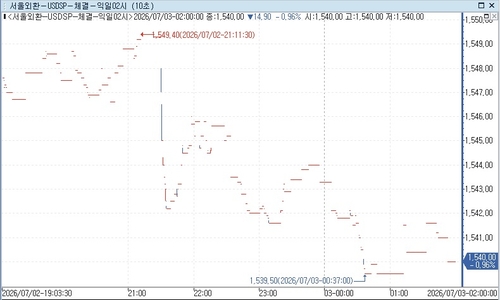
USD/KRW Extends Overnight Drop on Softer U.S. Jobs, Closes at 1,540.00 Won
USD/KRW widened its decline in overnight trading and closed at 1,540.00 won. The dollar lost momentum after U.S. employment data came in below expectations, while demand for the Korean won improved. At 1,540 won per dollar, $1,000 equals 1.54 million won before fees and spreads. The next move depends on Fed rate expectations, foreign flows into Korean market

Consumer Inflation Tops 3% Again as Oil and Chipflation Raise Korean Living Costs
Consumer prices have exceeded 3% for a second month, shaking the path back to price stability. Oil is raising fuel and logistics costs, while chipflation is affecting electronics, autos and servers. Korea’s reliance on imported crude and key components makes won-based costs more sensitive. Persistent inflation could delay rate-cut expectations.